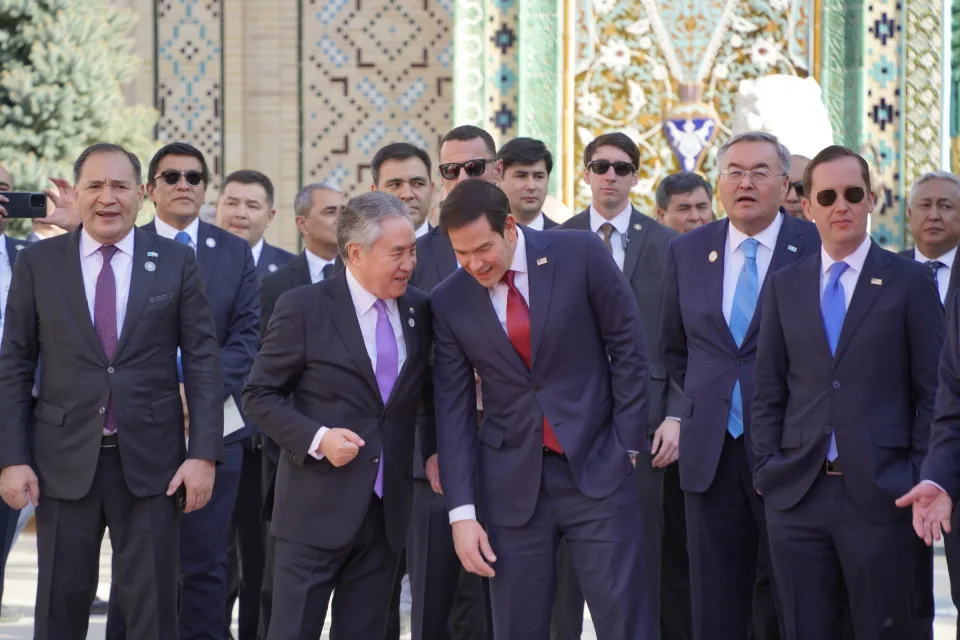
In September, I wrote about Marco Rubio’s planned visit to Samarkand and the growing interest of US business in Central Asia. That story now has concrete outcomes: a joint C5+1 statement, an Uzbekistan-US package of agreements and prospective initiatives estimated at around $12 billion, and separate talks between Kyrgyzstan and American partners.
On 19 October, Samarkand hosted the foreign ministers of the five Central Asian countries and the US Secretary of State. Rubio said that almost 300 American companies were represented in the city. In an interview with Euronews, he outlined Washington’s interest in a long-term economic presence and identified critical minerals as one area of cooperation. This involves diversifying sources of supply and developing mining and processing. Asked about China, Rubio stressed that the United States was not asking countries in the region to end relationships with other partners.
C5+1 outcomes: transport, minerals and technology
The joint C5+1 statement gave the economic agenda more specific content. Its priorities include developing the Trans-Caspian Trade Route and transport infrastructure, aligning customs procedures and expanding industrial cooperation. It also addresses energy, mineral extraction and processing, the exchange of expertise on geological data, and the production of more value-added goods within the region.
The document also covers digital trade, the B5+1 business platform, and educational and professional exchanges. Its security agenda includes counterterrorism, cross-border crime, border protection, cybersecurity and cooperation on the peaceful use of nuclear energy. The statement sets out broad areas of cooperation without allocating specific funding amounts to individual countries.
The Uzbekistan-US package of agreements and initiatives
The Uzbekistan-US component of the visit received the most prominent financial estimate. At the bilateral Business and Investment Council, President Shavkat Mirziyoyev announced a package of 54 agreements and prospective initiatives worth around $12 billion. The estimate includes prospective initiatives. A comprehensive action programme is to be prepared to implement the package.
Uzbekistan also outlined an approach under which investors would be offered prepared projects with sites, infrastructure, permits and documentation. The Uzbek side reported the establishment of a direct investment fund to participate in such projects and proposed a trade, investment and technology cooperation programme through 2035. The areas identified include advanced mineral processing, energy, data centres, artificial intelligence and workforce training.
Another outcome was Uzbekistan’s accession to the Artemis Accords, which set out principles for international cooperation in peaceful space exploration. The US Department of State confirmed that Uzbekistan became the initiative’s 77th signatory.
Kyrgyzstan: Boeing, investment and visa issues
For Kyrgyzstan, talks with Boeing provided a specific business focus. Foreign Minister Jeenbek Kulubaev met Mike Schnabel, the corporation’s vice president for international operations and policy. They discussed possible aircraft deliveries to Kyrgyz airlines and the preparation of commercial proposals.
The discussions covered financing terms with the possible involvement of the Export-Import Bank of the United States, EXIM Bank, as well as maintenance services and aviation infrastructure. The published account did not identify aircraft models, quantities or the potential value of a transaction. The talks remain described as discussions about prospects for cooperation.
At the wider C5+1 meeting, Kulubaev outlined Kyrgyzstan’s interest in transport corridors, logistics, energy, and the extraction and processing of critical minerals. Renewable energy, digital and space technologies were also on the agenda. The minister called for more favourable conditions for business and tourist travel, alongside expanded academic and humanitarian exchanges.
These issues also featured in his separate meeting with Rubio. The two sides discussed sanctions compliance, visa restrictions, and attracting US investment and technology. Kyrgyzstan reaffirmed its readiness to continue cooperation to prevent sanctions circumvention. The international agenda included cooperation in the UN Security Council, in view of Kyrgyzstan’s election as a non-permanent member for 2027–2028. The published account did not announce the lifting of restrictions or the signing of investment agreements.
From B5+1 in Bishkek to talks in Samarkand
The latest contacts build on Kyrgyzstan’s earlier engagement. On 4–5 February 2026, Bishkek hosted the second B5+1 Forum, the Central Asia-US business platform. According to organiser CIPE, the forum brought together 421 participants and representatives of more than 40 American companies. Discussions covered agriculture, finance, critical minerals, information technology, transport and tourism.
Kyrgyzstan’s part in the Samarkand talks shows how discussions of new economic projects intersect with the terms of bilateral cooperation. Contacts with American business are proceeding alongside talks on sanctions, visas and international security. This agenda brings together corporate interests, access to technology, travel and professional exchanges.
20 October 2026. Based on the published outcomes of the Samarkand leg of the visit.