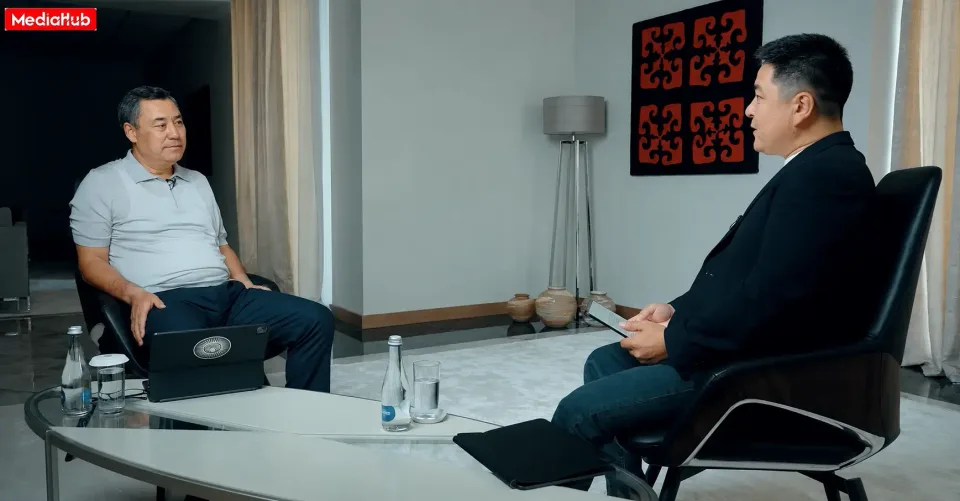
The interview, which lasted more than an hour and a half, was one of the most substantive recent public discussions of Kyrgyzstan's political and economic direction. Journalist Ali Toktakunov asked about Kumtor, the fight against corruption, the president's relationship with Kamchybek Tashiev, land leases, foreign labour quotas, public debt, cooperation with China, industrial development and the future of political leadership.
The conversation offered insight into how President Sadyr Japarov explains the decisions already taken and how he sees the country's next stage of development. Its significance therefore extends beyond individual statements. The interview sets out the broader logic of the current policy: a stronger state role in strategic sectors, the restoration of control over key assets, the development of domestic industry, the attraction of investment and reduced external dependence.
Key point: the interview does not resolve every issue under public discussion, but it shows that the president has a coherent view of the country's development. At its core are a stronger role for the state, control over strategic resources, investment attraction, industrialisation, infrastructure development and reduced external dependence.
Political Responsibility and the Question of Succession
One of the most notable subjects was the country's political future and the possibility that Kamchybek Tashiev might contest the next presidential election. The head of state said that his ally could stand as a candidate, while stressing that the final decision must be made through elections.
This part of the interview matters for several reasons. First, the president did not present succession as a closed agreement within the government. Second, he linked the legitimacy of the country's future leader to the will of the electorate. Third, he signalled that political stability should not depend on a single individual.
Support for a particular candidate from an incumbent president would, of course, carry significant political weight. The central point, however, is the framework itself: a transfer of power is presented as an open electoral process rather than a predetermined outcome.
Corruption: Fewer Headline Figures, More Verification
The head of state also addressed public claims about the results of the fight against corruption. The figure under discussion was 300 billion soms. The president clarified that such estimates may have been overstated, because public calculations may have combined actual budget receipts, the value of recovered property and broader estimates of losses prevented.
This clarification is important. Anti-corruption policy should not be judged by the most impressive headline figure, but by verifiable results: how much money actually entered the budget, which assets were returned to the state, which decisions withstood judicial scrutiny and which reforms reduced the likelihood of repeat violations.
The public correction of a prominent figure can itself be seen as evidence of a more responsible approach to official statistics. Public trust is better served by a verifiable amount and a transparent methodology than by an eye-catching claim.
Kumtor as a Symbol of Restored Control
Kumtor remains central to any assessment of the president's policy. In the interview, Sadyr Japarov again presented the transfer of the mine to state control as the restoration of economic sovereignty and the end of a model under which a substantial share of the benefits from a strategic resource left the country.
The president also cited examples of expenditure and management decisions from the previous period, including the cost of an overseas office and individual high-value purchases. The head of state has previously described the damage caused by the former management model as substantial for Kyrgyzstan.
Kumtor's political significance extends beyond a single enterprise. For the current administration, it has become evidence that the state is capable of revising unfavourable arrangements and assuming responsibility for managing a major asset. The economic outcome of this policy should be judged by long-term indicators: production volumes, tax and dividend payments, environmental commitments, investment levels and the quality of corporate governance.
Nevertheless, the transfer of control to Kyrgyzstan has already changed public perceptions of the relationship between the state and major investors. The message is not a rejection of foreign capital, but a requirement that the terms of cooperation take the country's interests into account.
Land Must Be Put to Productive Use, Not Sold
The discussion of land leases for terms of up to 49 years addressed a sensitive question: how can long-term investment be attracted without creating a risk of losing control over a national resource? The president described the proposed model as a staged arrangement. An initial agreement would be concluded for 10 years and could then be extended to 25 and 49 years if the investor fulfils its obligations.
The economic rationale is clear. Major projects in agriculture, processing, logistics, tourism and energy require a long investment-recovery horizon. A short lease often makes such investment commercially unviable. At the same time, the land is not sold and remains the property of the state or of Kyrgyz citizens.
Staged extensions make it possible to link the duration of land use to the investor's actual performance. If the promised investment is not made or the plot is used for a purpose other than the one agreed, the state retains the ability not to extend the lease.
The proposal therefore concerns a mechanism for long-term use subject to specific obligations, not the transfer of land to foreign ownership. Its effectiveness will depend on how clearly the agreements define the level of investment, deadlines, designated use and grounds for terminating the lease.
Further reading: Land Must Be Put to Productive Use: Why Kyrgyzstan Is Tightening Its Land Lease and Land-Use Rules.
From Imports to Industrial Development
The interview consistently returned to the idea of moving from an economy of consumption towards an economy of production. This has become one of the central elements of government policy in recent years. According to official data, 102 enterprises with total investment of approximately $800 million opened in 2024. A target of launching another 100 industrial facilities has been set for 2026.
Industrial development matters to Kyrgyzstan in several ways. New enterprises create jobs, broaden the tax base, increase export potential and reduce dependence on imports. Projects that process domestic raw materials inside the country, rather than exporting them without added value, are particularly important.
The president's approach can be described as pragmatic industrialism. The state seeks not only to improve the general business environment, but also to participate directly in launching strategic projects, developing infrastructure and attracting capital.
The scale of the projects under discussion shows that industrialisation is viewed not as a stand-alone programme, but as the foundation of long-term economic self-reliance. The long-term outcome will depend on how consistently these decisions are implemented and embedded in the system of public administration.
Foreign Labour: The Needs of a Growing Economy
Foreign labour quotas deserve separate attention. In 2026, the quota for foreign workers was increased from 52,000 to 100,000. In public debate, this figure is sometimes treated as the number of workers who have already arrived. In fact, the quota is a maximum permitted ceiling, not an automatic recruitment target.
The higher limit reflects growth in construction, industry and infrastructure projects. In certain sectors, the country faces a shortage of workers with the required skills. At the same time, many Kyrgyz citizens continue to work abroad, creating a paradox: new projects are emerging at home, but the domestic labour market cannot always supply the necessary workforce quickly enough.
In these circumstances, foreign labour does not necessarily displace local workers. It can address a temporary shortage and allow projects to proceed without delay. At the same time, the measure highlights the need for systematic investment in training domestic specialists.
The most effective model would combine quotas with vocational education, retraining, higher labour productivity and obligations for employers to increase the share of local staff over time. Foreign workers would then supplement the labour market rather than substitute for the development of national skills.
Fuel and the Need for Domestic Refining
Dependence on imported petroleum products remains one of the economy's vulnerabilities. Domestic prices are heavily influenced by external supplies, logistics and conditions in regional markets. Government bodies regularly assess fuel prices and the reasons behind their movements.
In the interview, the president linked a solution to this problem with the development of domestic refining. This approach is consistent with the broader economic policy: the country should not merely import finished products, but should also build production capacity within Kyrgyzstan.
Domestic refining capacity cannot eliminate the influence of world prices, since both raw materials and technology are also tied to external markets. It can, however, improve supply resilience, create jobs and retain a larger share of added value within the country.
Public Debt and GDP: Why Proportions Matter
Assessing public debt by its absolute size alone is insufficient. The debt-to-GDP ratio is more informative because it places the country's obligations in relation to the size of its economy.
At the end of 2025, Kyrgyzstan's public debt stood at approximately 39.5% of GDP. External debt accounted for about 23.7% and domestic debt for 15.8%. The president instructed the government not to allow total public debt to rise above 50% of GDP.
For comparison, the International Monetary Fund uses an indicative benchmark when assessing debt sustainability in low-income countries. In its 2026 assessment, the IMF classified Kyrgyzstan's debt-carrying capacity as strong and set the indicative benchmark for the present value of total public debt at 70% of GDP. The actual present value of public debt was estimated at approximately 34.3% of GDP in 2025 and remained below that benchmark under the baseline scenario.
This does not mean that debt can be increased without constraint. The IMF assessed the overall risk of debt distress as moderate, because sustainability depends not only on the debt-to-GDP ratio, but also on the currency composition of liabilities, the repayment schedule, export earnings, borrowing costs and the budget's capacity to service debt.
Against this background, the domestic ceiling of 50% of GDP appears more conservative than the IMF's indicative benchmark. It preserves room to finance infrastructure while requiring the state to select projects capable of generating an economic return.
Chinese Loans: Cooperation Without Dependence
China remains one of Kyrgyzstan's largest creditors and economic partners. According to the Ministry of Finance, outstanding debt to the Export-Import Bank of China was approximately $1.4 billion at the end of June 2026.
In the interview, the president stressed that Chinese financing had primarily been used for major infrastructure projects. At the same time, he set out a policy of gradually reducing external obligations and taking a more cautious approach to new borrowing.
Two issues should be distinguished here. The first is the quality of the individual projects financed through these loans. The second is the country's foreign-policy orientation. Significant debt to a single creditor does not in itself amount to political dependence, provided that the state maintains diversified relations and meets its obligations without surrendering strategic assets.
Relations with China are therefore presented not as a move towards one-sided dependence, but as one instrument of infrastructure and economic development. The essential condition is the state's ability to service its obligations while retaining control over strategic decisions.
Foreign Policy: Pragmatic Balance and National Interests
In the interview, foreign policy emerged primarily through the discussion of China, borrowing and major infrastructure projects. The president's answers, however, point to a broader logic. Kyrgyzstan does not tie its course to a single centre of power and seeks to develop relations with all states where cooperation serves the national interest. This is how the head of state has previously defined the country's multi-vector foreign-policy principle.
Russia remains a strategic ally and one of Kyrgyzstan's most important partners. Relations between the two countries encompass trade, labour migration, energy, security, humanitarian ties and participation in Eurasian integration arrangements. The president has consistently described Russia as an ally and reliable partner, without presenting that relationship as incompatible with cooperation with other countries.
China holds a particular position as a major trade, investment and infrastructure partner. The railway linking China, Kyrgyzstan and Uzbekistan, together with energy and industrial projects and the expansion of transport routes, could reshape the country's economic geography. In the interview, however, the head of state emphasised that partnership should strengthen Kyrgyzstan's autonomy rather than create political dependence.
Central Asia is another priority. The normalisation of relations with neighbouring states, the settlement of border issues and the shift from conflict towards joint projects are creating a more favourable regional environment for Kyrgyzstan. The head of state has linked this process to the emergence of a new atmosphere of trust and good-neighbourly relations. For a landlocked country, stable relations with Kazakhstan, Uzbekistan and Tajikistan directly affect trade routes, energy, water resources and investment attractiveness.
Kyrgyzstan is also broadening its engagement with Türkiye, the European Union, the United States, Arab and Asian states, and international financial institutions. In this context, a multi-vector policy does not mean maintaining equally deep relations with every partner. It means preserving room for choice and avoiding an artificial opposition between different directions.
The foreign-policy course presented by the president can be described as pragmatic. Its durability depends not only on diplomatic balance, but also on the country's domestic economic capacity to produce more of its own goods, develop energy and transport corridors, service debt and offer mutually beneficial projects to its partners. Foreign policy therefore extends the interview's broader theme of economic sovereignty: the stronger the domestic economy, the greater the state's ability to determine its partners and the terms of cooperation independently.
The Value of Direct Dialogue
The format of the conversation deserves separate consideration. The interview was conducted by a journalist known for critical investigations and challenging questions. The president did not limit himself to brief statements, but responded at length on the most contentious issues.
This does not imply that the two participants shared the same views. On the contrary, the value of such a conversation lies in the opportunity to state disagreements openly and give the public material on which to form its own judgement.
At the same time, a single interview cannot by itself settle the broader debate about the conditions in which the media operate. Questions of law enforcement, professional responsibility and journalistic freedom continue to be discussed both within the country and internationally. It is therefore particularly important that the practice of direct and substantive dialogue with media representatives continues to develop.
What the Interview Reveals About the State's Direction
The central conclusion from the conversation is that the president sees Kyrgyzstan's development as requiring a stronger and more active state. It should control strategic resources, participate in the creation of new industries, develop infrastructure, attract investment on clear terms and keep debt at a manageable level.
In this model, market mechanisms are not abandoned, but the state ceases to be a passive observer. It seeks to set a direction, restore control over key assets and create the conditions for long-term projects.
The interview shows that current policy is built around several interconnected objectives:
- strengthening economic sovereignty;
- developing industry and domestic processing;
- attracting investment without selling strategic resources;
- maintaining public debt at a manageable level;
- addressing labour shortages while training domestic specialists;
- preserving a multi-vector foreign policy;
- ensuring political succession through elections.
Together, these priorities offer a coherent view of the country's future. The president's emphasis is on practical decisions, infrastructure, production and the state's ability to defend its interests.
The next stage should be to embed the decisions already taken in durable state institutions. If the reforms under way are supported by clear rules and professional administration, they can provide Kyrgyzstan with a more self-reliant and resilient model of development.