On 21 September 2026 in New York, President of the Kyrgyz Republic Sadyr Japarov held a series of meetings with representatives of US business and international financial institutions.
The most notable elements were a meeting with US business circles and the presentation of a recognition award linked to the US-Kyrgyzstan Business Council, talks with StoneX Group, and a separate meeting with the leadership of Citi.
Taken together, these developments reflect several different levels of engagement: a reputational signal from the business community, access to international financial and banking infrastructure, work with commodity markets, and the potential expansion of channels for raising capital.
Cover photo: Press Service of the President of the Kyrgyz Republic.
What the US-Kyrgyzstan Business Council award means
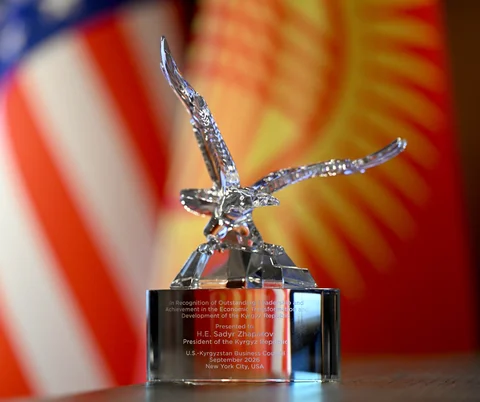
During the meeting with US business representatives, Sadyr Japarov was presented with a recognition award.
The inscription states that it was presented “In Recognition of Outstanding Leadership and Achievement in the Economic Transformation and Development of the Kyrgyz Republic.” The base of the award refers to the US-Kyrgyzstan Business Council, New York City and September 2026.
That distinction matters for how the event should be interpreted.
This was not a state award of the United States, nor was it an assessment by an international rating agency. It was recognition from a business organization and participants in the business dialogue. Its significance is primarily reputational: it reflects a positive assessment of Kyrgyzstan’s economic trajectory by participants in that dialogue.
Economic backdrop: double-digit growth and strong investment activity
The positive assessments came against the backdrop of high economic growth.
According to preliminary data from the National Statistical Committee, Kyrgyzstan’s GDP reached KGS 1.3968 trillion in January-August 2026, up 11% from the same period of 2025.
Industrial output reached KGS 600.8 billion, with the industrial production volume index at 108.8%. The National Statistical Committee also recorded growth of 33.4% in construction materials, 46.8% in vehicle production, a 1.8-fold increase in refined petroleum products and a 2.3-fold increase in chemical products.
Investment activity was also notable. Fixed-capital investment in January-August reached 161.2% of the level recorded in the same period of 2025. Construction expanded by about 61%, while its share of GDP increased from 6.4% to 8.4%.
These figures do not by themselves provide a complete assessment of the quality or long-term sustainability of growth. They do, however, provide the macroeconomic context in which stronger interest from foreign business becomes easier to understand.
Why the US-Kyrgyzstan Business Council matters
The US-Kyrgyzstan Business Council is an independent business organization focused on developing commercial ties between Kyrgyzstan and the United States.
It is not a US government body. Its role is business engagement: connecting companies, supporting trade and investment dialogue, and facilitating more direct communication between US business and the Kyrgyz market. The US Department of Commerce has also referred to the US-Kyrgyzstan Business Council in the context of commercial engagement between the United States and Central Asia.
The significance of the New York event should therefore be measured less by the formal status of the award and more by a practical question: can stronger business interest translate into actual projects and transactions?
StoneX: from business contact to financial infrastructure
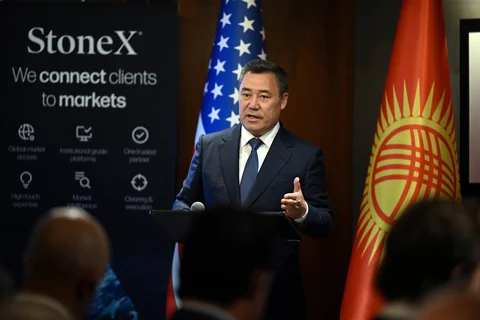
On the same day, Sadyr Japarov visited the New York office of StoneX Group and met with the company’s leadership.
The discussions covered precious-metals trading, price-risk management, international settlements, modern financial instruments and the possible use of StoneX’s international infrastructure for projects in Kyrgyzstan.
Two memoranda of understanding were signed following the talks:
- between the Ministry of Finance of the Kyrgyz Republic and StoneX Group;
- between Eldik Bank and StoneX Group.
The practical relevance of such cooperation extends beyond potential financing. For an economy in which gold and other commodities remain important, access to price-risk management tools, international settlement infrastructure and global financial markets can be significant.
At the same time, a memorandum is a framework document. The economic outcome can only be assessed later, through actual transactions, specific financial products, completed deals and the volume of capital mobilized.
Meeting with Citi: a relationship that already has a track record
Another significant part of the New York program was Sadyr Japarov’s meeting with Stephanie von Friedeburg, Citi’s global head for the public sector.
The discussion covered financial and banking cooperation, international payments, investment interaction and broader access for Kyrgyz banks to international financial infrastructure.
The important point is that Kyrgyzstan’s relationship with Citi did not begin with this meeting. In January 2025, the Kyrgyz side had already discussed access to international capital markets and the development of correspondent banking relationships with Citi. In April 2026, state-owned Eldik Bank placed its debut $500 million Eurobond, with Citigroup acting as one of the transaction’s arrangers and bookrunners.
The New York talks also addressed new correspondent relationships between Citi and Kyrgyz state-owned banks, as well as the possibility of opening a Citi branch in Kyrgyzstan.
Sadyr Japarov presented several major projects, including the China-Kyrgyzstan-Uzbekistan railway, Kambarata HPP-1, Asman City and the Ala-Too Resort ski cluster. Citi representatives expressed interest in expanding correspondent relations and considering opportunities to participate in projects.
Three memoranda of understanding were signed following the meeting:
- between the Ministry of Finance of the Kyrgyz Republic and Citi;
- between Eldik Bank and Citi;
- between ABank and Citi.

What cooperation with Citi could potentially bring to Kyrgyzstan
It is important to separate possible mechanisms from guaranteed outcomes.
First, international payments and correspondent banking. Direct or expanded correspondent relationships with a major global bank could give Kyrgyz banks additional channels for international payments and client servicing. The actual effect would depend on the terms of each arrangement, compliance requirements, currencies and the range of available transactions.
Second, access to capital markets. The Eurobond placement already demonstrates Citi’s practical role as an arranger and bookrunner. That experience could be relevant to future sovereign, bank or corporate issues, provided issuers meet the requirements of international investors.
Third, financing for major projects. Railways, energy infrastructure, tourism clusters and large urban projects typically require multiple sources of capital. A global bank can potentially participate in financing structures, investor outreach, syndicated lending or advisory work. Participation in any specific project, however, comes only after assessment of the financial model, risks and bankability.
Fourth, a possible physical Citi presence in Kyrgyzstan. Discussing a branch does not mean that a decision to open one has been made. If the idea proceeds and receives the necessary regulatory approvals, a branch could potentially broaden direct access for major clients and financial institutions to international banking infrastructure.
The key word is potentially. Memoranda and high-level discussions create channels for engagement, but the financial impact materializes only when concrete transactions are agreed and executed.
StoneX and Citi serve different functions
StoneX and Citi should not be viewed as interchangeable partners.
In this context, StoneX is more closely associated with financial and commodity markets, precious-metals operations, hedging, international settlements and market-risk management.
Citi offers a different set of capabilities: international banking, correspondent relationships, capital markets, financing structures and access to a global network of institutional clients and investors.
For Kyrgyzstan, the two tracks can be complementary. StoneX can strengthen the infrastructure for working with markets and commodity flows, while engagement with Citi can potentially broaden access to international financing and banking channels.
The real test is converting interest into transactions
The New York meetings sent several signals at once.
On one side, the US-Kyrgyzstan Business Council and representatives of the business community publicly recognized economic changes in Kyrgyzstan. On the other, the StoneX and Citi discussions already touched on specific financial mechanisms and resulted in five memoranda.
For the economy, however, the real test begins after the ceremonies and signings.
The practical significance will be measured by whether the meetings lead to new correspondent relationships, concrete credit and investment instruments, new international capital-market transactions, financing for infrastructure projects and long-term participation by international companies in the Kyrgyz market.
Domestic conditions matter just as much: protection of property rights, regulatory predictability, the speed of permitting procedures, access to power and utility infrastructure, effective commercial-dispute mechanisms and transparent rules for investors.
The combination of external interest and the domestic capacity to bring projects to financial close will ultimately determine the practical significance of this stage in Kyrgyz-US business relations.
In that context, the recognition award in New York can be seen as a symbolic marker. The more substantive result will be the transactions that follow.