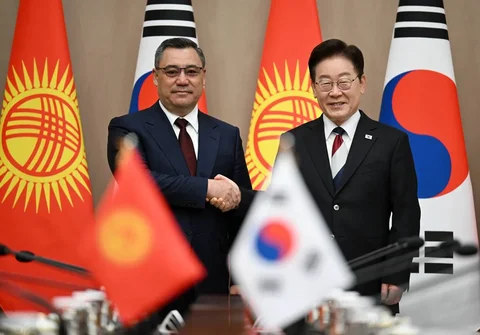
On 16 September 2026, Seoul hosted the first Republic of Korea-Central Asia Summit at the level of heads of state. President Lee Jae-myung of the Republic of Korea was joined by the leaders of Kazakhstan, Kyrgyzstan, Tajikistan, Turkmenistan and Uzbekistan.
The move to a summit-level format is significant. Cooperation between the Republic of Korea and Central Asian countries had already developed through bilateral relations and the Korea-Central Asia Cooperation Forum, established in 2007. The new summit format elevates that engagement to the level of heads of state, while the Seoul Declaration provides a longer-term framework for regional cooperation.
For Kyrgyzstan, this creates additional opportunities in trade, investment, infrastructure and technological cooperation.
From political dialogue to economic infrastructure
In the global economy, supply-chain resilience, access to raw materials and technology, and market diversification are becoming increasingly important.
For the Republic of Korea, which has strong positions in automobiles, electronics, battery technology, engineering and other advanced industries, Central Asia is relevant at the same time as a resource region, an emerging market and a platform for industrial and infrastructure cooperation.
At the business summit in Seoul, President Lee Jae-myung identified three areas for further cooperation: expanding trade and investment, building a full critical-minerals supply chain, and developing future-oriented infrastructure.
Before the main session, 19 commercial memorandums were signed in areas including critical minerals, smart cities, industrial construction and digital technologies.
A relatively clear logic is emerging: Central Asia's resource and market opportunities can be combined with the Republic of Korea's technological, industrial and investment capabilities.
Kyrgyzstan in Korea's new regional strategy
For the Republic of Korea, each Central Asian country presents a different set of opportunities depending on the structure of its economy, resource base, infrastructure needs and potential for technological cooperation.
Kyrgyzstan is also developing its own track within this broader regional framework.
The outcomes of the talks between President Sadyr Zhaparov and President Lee Jae-myung show that the bilateral agenda now extends well beyond traditional political dialogue.
The two sides identified cooperation in trade and investment, critical minerals, urban infrastructure, development cooperation, food security, public administration, security and emergency response, artificial intelligence, climate, education and humanitarian ties.
Following the Kyrgyz-Korean talks, relevant agencies and organizations signed 18 agreements and memorandums.
Of particular importance is the emergence of practical mechanisms that could make it easier for Korean companies to enter the Kyrgyz market and support joint projects.
KOTRA comes to Bishkek
One of the most practical decisions was the agreement to open a KOTRA office in Bishkek.
The Korea Trade-Investment Promotion Agency supports international trade and helps Korean companies enter overseas markets.
For Kyrgyzstan, having KOTRA directly present in Bishkek could have tangible practical value.
For a foreign company, entering a new market involves more than assessing commercial potential. It also requires understanding local regulation, identifying partners, evaluating projects, navigating permitting procedures and dealing with public authorities.
A permanent Korean institutional presence in Bishkek can potentially reduce some of these barriers and make the Kyrgyz market easier for Korean businesses to assess.
Korea Desk at the National Investment Agency
A second important decision was the creation of a Korea Desk at the National Investment Agency under the President of the Kyrgyz Republic.
The Korean side explicitly stated that the KOTRA office in Bishkek and the Korea Desk are intended to strengthen support for companies from both countries.
In practical terms, this creates a dedicated channel for supporting Korean investors and interacting with Kyrgyz public institutions.
If the mechanism develops into an effective one-stop platform, its value could extend across the entire investment cycle: from the first inquiry and site selection to permitting, infrastructure and the launch of operations.
This is often the level at which a diplomatic understanding either becomes a real investment project or does not.
Critical minerals: an opportunity, not yet a result
Critical minerals are another area that deserves attention.
South Korea is seeking to diversify raw-material supplies for its high-technology industries, which is why critical minerals featured prominently both at the regional summit and in bilateral talks.
Kyrgyzstan and the Republic of Korea agreed to explore promising joint projects based on the complementary advantages of the two countries.
However, the existence of mineral resources alone does not automatically integrate a country into an international supply chain. Industrial projects depend on verified reserves, extraction economics, infrastructure, energy supply, environmental requirements and processing capacity.
That makes cooperation in processing, technology and the creation of greater domestic value added at least as important as extraction itself.
This approach is consistent with the broader logic set out at the business summit: cooperation on critical minerals should cover the entire value chain rather than isolated raw-material shipments.
Urban infrastructure may be just as important
For Kyrgyzstan, cooperation with Korea is not limited to mineral resources.
The bilateral meeting also established a basis for cooperation in urban planning and infrastructure, public-private partnerships and smart grids.
This is particularly relevant for Bishkek and other growing cities where demand for transport, energy and utility infrastructure continues to increase.
Korean companies have expertise in smart cities, public transport, intelligent transport systems, digital urban management, energy and construction.
Potential areas of cooperation therefore include traffic management, electric public transport, network modernization, smart grids, water-supply and treatment systems, and public-private partnership projects.
Smart-city and infrastructure projects were also among the areas covered by commercial agreements signed at the regional business summit.
The next practical stage could be the development of specific projects that combine Korean technology and capital with Kyrgyzstan's infrastructure needs.
AI and digitalization
Another promising area is digital technology.
Kyrgyzstan and the Republic of Korea agreed to develop cooperation in artificial intelligence, while digital transformation also became part of the broader Korea-Central Asia partnership agenda.
South Korea is relevant here not only as a supplier of hardware. It has accumulated substantial experience in the digitalization of public administration, e-government services, urban infrastructure and information systems.
For Kyrgyzstan, cooperation in these areas may be attractive because some digital solutions can be implemented considerably faster than large-scale resource or infrastructure projects.
The key issue is not the number of memorandums
The Seoul summit created a political and institutional framework that had not previously existed at the level of heads of state.
But there is always a significant distance between signing a memorandum and launching an operating enterprise, infrastructure facility or technology platform.
The practical impact for Kyrgyzstan will therefore depend to a large extent on how quickly the broader agenda is translated into concrete investment projects.
An important role could be played by the development of a clear investment pipeline: projects with a sound economic model, a defined site, infrastructure conditions, permitting requirements and responsible parties.
For a Korean investor, the quality of the individual investment proposition can matter just as much as the general potential of a country or sector.
This is why KOTRA in Bishkek and the Korea Desk at the National Investment Agency could become important links between political agreements and business implementation.
Competition for Korean capital
There is another factor to consider.
The Republic of Korea is developing relations with all five Central Asian states. Each country offers Seoul its own resources, projects and markets.
In this context, further highlighting Kyrgyzstan's own competitive advantages and the areas where cooperation with Korean business can develop most practically becomes particularly important.
These areas may include energy and hydropower, selected mineral resources, tourism, urban infrastructure, digitalization, logistics and projects linked to new regional transport corridors.
At the business summit, Sadyr Zhaparov specifically invited Korean companies to consider participation in energy projects, including Kambarata HPP-1 and new hydropower plants, as well as projects along the China-Kyrgyzstan-Uzbekistan railway under construction, tourism infrastructure and digital technologies.
This means that the bilateral agenda already includes not only broad sectors, but also specific project directions.
From the first summit to real investment
The first Republic of Korea-Central Asia Summit shows that Seoul's engagement with the region is becoming more institutionalized and more economically focused.
For Kyrgyzstan, the meetings of 16 September created a substantive foundation for further cooperation: 18 bilateral documents, the opening of KOTRA in Bishkek, the creation of a Korea Desk, and cooperation in critical minerals, urban infrastructure, investment, AI and other technology-related areas.
The next stage will depend less on diplomatic framing and more on the quality and implementation of specific projects.
If the new mechanisms begin to generate investment, joint ventures and technology deployment, the September summit in Seoul may come to be seen as the beginning of a new stage in Kyrgyz-Korean economic cooperation.